
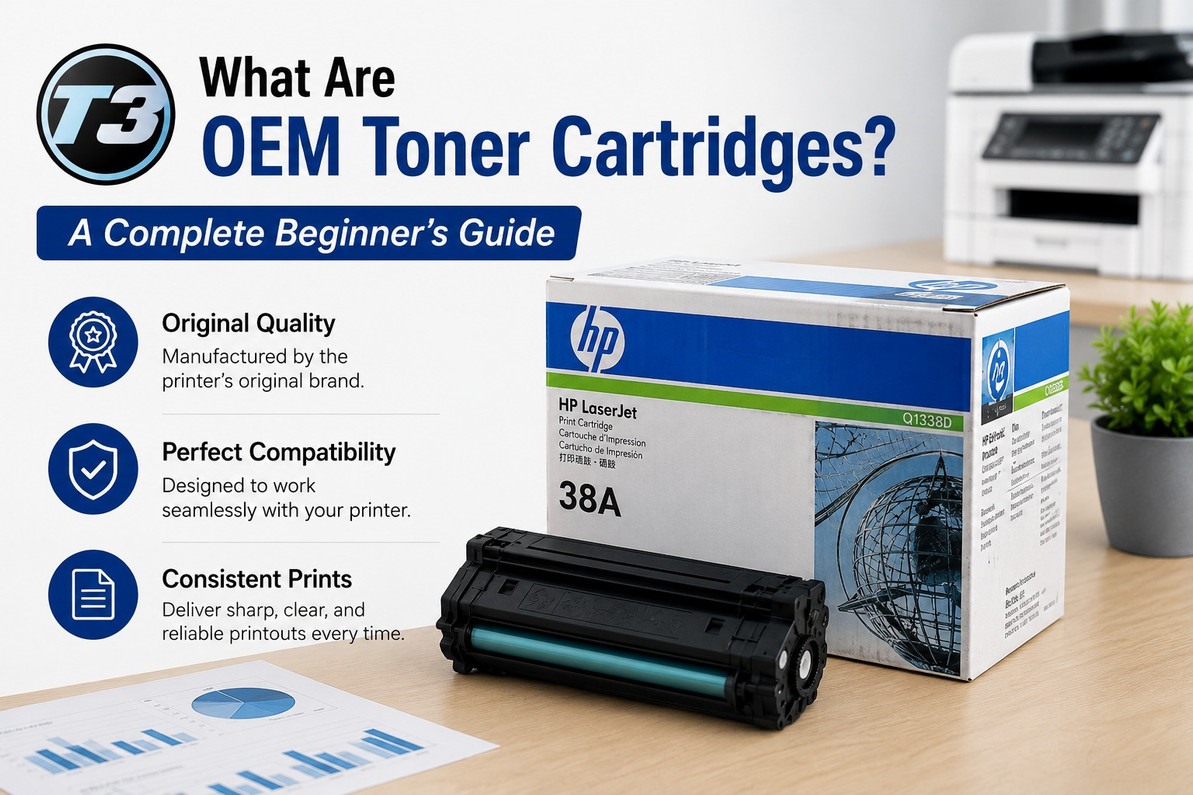
What Are OEM Toner Cartridges? A Complete Beginner's Guide
If you've been shopping for toner online, you've probably noticed the word "OEM" stamped on a chunk of the listings, usually next to a price that's a good bit higher than everything around it. So the obvious question is whether that badge means anything or whether you're just paying more for a logo. Here's the full breakdown.
What OEM Actually Means
OEM stands for Original Equipment Manufacturer. In printing, it means the same company that built your printer also made the cartridge going into it. If you own a Canon printer and buy a Canon cartridge, that's OEM. Same goes for HP, Brother, Epson, Lexmark, or whoever manufactured your machine.
Think of it like car parts. You can buy an original component straight from the automaker, or you can pick up an aftermarket version that's built to fit but came from a different company. Both can get the job done. The difference is that one was engineered alongside the machine it's going into, and the other was reverse-engineered to match it.
Two other terms tend to get lumped in with OEM, and it's worth keeping them straight. Compatible cartridges are new units built by third parties to fit your printer. Remanufactured cartridges are used OEM shells that have been cleaned out and refilled. We'll come back to both.
A Quick Look at How Toner Works
This part is worth understanding, because it explains why OEM makes a difference at all.
Laser printers don't spray liquid ink the way an inkjet does. A laser draws your document onto a charged drum, and toner powder, which carries its own charge, clings to the areas of the drum that match your text and images. That powder gets pressed onto the paper and then melted into place by a heated roller.
That heat-fusing step is the reason toner has to be formulated so precisely. Get the particle size or melting point wrong and you end up with smudging, faded patches, or powder that won't bond to the page. Manufacturers pour real R&D money into tuning their formula for their specific printers, which is a big reason their own cartridges perform so consistently.
Why Printer Companies Make Their Own Toner
Here's a detail most people miss. Printer makers often earn very little on the printer itself. In some cases they sell the machine close to cost. The profit shows up later, through cartridge sales over the life of the printer. It's the razor-and-blades model: cheap handle, pricier refills.
That's not a hidden agenda, it's just how the industry has run for decades. It also explains why manufacturers build authentication chips into their cartridges. Keeping you inside their supply chain is the whole point.
What's Inside a Toner Cartridge
Open one up, and you'd find a few parts working together:
- Toner powder made from plastic resin and pigment, formulated to melt and bond correctly for that exact printer model.
- A drum unit, which is sometimes built into the cartridge and sometimes sold on its own.
- A wiper blade that scrapes leftover toner off the drum after each print.
- A chip that reports toner levels to the printer and, in many cases, tells the printer whether the cartridge is approved to run at all.
That last piece is the one that stirs up the most debate. Some manufacturers use these chips to block cartridges purchased in one country from working in a printer sold in another, or to stop refilled cartridges from being recognized. There have been lawsuits over companies cracking these chips so their compatible cartridges could function.
Why People Stick With OEM
The main draw is consistency. Because the cartridge was engineered for your specific printer, you're not gambling on toner density, fit, or print quality.
There's also less risk to the printer itself. A cheap, poorly sealed cartridge can leak powder into places it shouldn't, and over time that can damage the fuser or drum. Repairing that costs far more than whatever you saved on the bargain cartridge.
Warranty coverage is another factor people overlook. Plenty of manufacturers state outright that damage caused by non-OEM cartridges isn't covered. If a technician traces a failure back to a third-party cartridge, that repair bill can land on you.
Page yield numbers also tend to hold up better with OEM. These are usually tested under standardized methods, such as ISO/IEC 19752 for monochrome or ISO/IEC 19798 for color, which print a standard test page at 5% coverage until the toner runs out. That gives you a real comparison between cartridges instead of a number invented for the box.
Where OEM Falls Short
Price is the obvious drawback. Depending on the brand, OEM can run anywhere from 30% more to well over double the cost of a comparable third-party cartridge.
Then there's region locking. Buy an OEM cartridge overseas and your printer may simply refuse to recognize it, which is frustrating if you were trying to save money by importing.
Availability gets tricky with older printers too. Once a model is discontinued, manufacturers often stop making cartridges for it, which can leave third-party options as your only choice whether you wanted them or not.
OEM vs Compatible vs Remanufactured
OEM cartridges come from your printer's manufacturer, built with their own toner formula and specs. They're the most expensive and the most consistent, and they keep your warranty intact.
Compatible cartridges are brand new but made by outside companies to fit your printer. They don't use the original formula or design, so quality depends heavily on who built it. Some brands are excellent. Others are a coin flip.
Remanufactured cartridges start as real OEM shells. After the toner runs out, they're taken apart, cleaned, inspected for worn parts, refilled, and tested before resale. This is usually the greener choice, since you're reusing the existing hardware instead of producing new plastic. Quality comes down to how careful the remanufacturer is.
Look at Cost Per Page, Not the Sticker
This is the one number worth sitting down and calculating. The sticker price tells you very little on its own. Cost per page tells you everything.
Say a cartridge costs $80 and prints 2,000 pages. That works out to 4 cents per page. Now take a cheaper cartridge at $40 that only lasts 800 pages. That's 5 cents per page, which makes the "cheaper" cartridge the more expensive one once you do the math.
This is exactly why the ISO-tested yield matters more than comparing prices on a shelf.
How to Spot a Counterfeit
Fake cartridges are a bigger problem than most buyers assume, especially through unknown third-party sellers online. The safest move is buying directly from the manufacturer or a listed authorized dealer. Check the packaging for holograms, serial numbers, or QR codes, since most manufacturers add these specifically to fight counterfeits. If a price looks too good to be true, treat it as a red flag. Many manufacturers also let you enter a serial number on their website to confirm the cartridge is legitimate.
So Do You Actually Need OEM?
It depends on what you print and how much it matters when something goes wrong. If you're running a business and printing client-facing documents, legal paperwork, or anything where downtime costs you money, OEM reliability usually earns its price.
If you're printing homework, everyday paperwork, or casual documents at home, a good compatible or remanufactured cartridge can save you real money with little downside.
The smartest approach is to run the cost-per-page math for your own printer and decide how much risk you're comfortable carrying.
The Bottom Line
OEM toner cartridges come from the same company that built your printer, and they're designed as part of that system rather than bolted on afterward. That's why they tend to print consistently, protect your warranty, and hit their advertised page counts. The tradeoff is a higher price and the occasional region restriction.
There's no single right answer. It comes down to how much you print, what you're printing, and how much that consistency is worth to you. At least now you know what's happening inside the cartridge and how to weigh the decision for yourself.
Frequently Asked Questions
Are OEM toner cartridges worth the extra money?
For businesses or anyone printing important documents regularly, usually yes. For casual home printing, running your own cost-per-page math is a smarter way to decide than trusting the price on the shelf.
Does using a non-OEM cartridge void my printer's warranty?
It depends on the manufacturer's terms. Some exclude damage caused by non-OEM cartridges, so it's worth reading your printer's warranty before you switch.
How is page yield tested?
Most manufacturers follow ISO/IEC standards, printing standardized test pages at 5% coverage until the cartridge is empty. This makes the numbers comparable across brands.
Can I refill an OEM cartridge myself?
You can, but it's risky without the right tools and experience. A botched refill can leak, print unevenly, or damage your printer's fuser or drum. Professional remanufacturing is the safer route.
Is OEM toner better for color printing?
Generally yes, since manufacturers tune their color formulas for their own machines. It matters more for photos and graphics than for basic text.
How do I know a cartridge is genuine OEM and not counterfeit?
Buy from the manufacturer or an authorized seller, check the packaging for holograms and serial numbers, and use the manufacturer's online verification tool if one is available.
Which option is most environmentally friendly?
Remanufactured cartridges usually come out ahead, since they reuse the original hardware instead of producing new plastic. Quality still depends on who did the remanufacturing.
Recent Posts
-
Samsung Printer Ink: Choosing the Right Toner for Your Printer
If your Samsung printer has suddenly started producing pale text, uneven graphics, or documents that …20th Oct 2026 -
Dell Laser Printer Cartridges: How to Choose the Right Toner
At some point, every office using a Dell laser printer has to replace the toner. The printer may hav …18th Oct 2026 -
MFP M283fdw Toner – Compatible & Quality Cartridges
The HP Color LaserJet Pro MFP M283fdw is designed for offices that need more than basic printing. Th …14th Oct 2026