
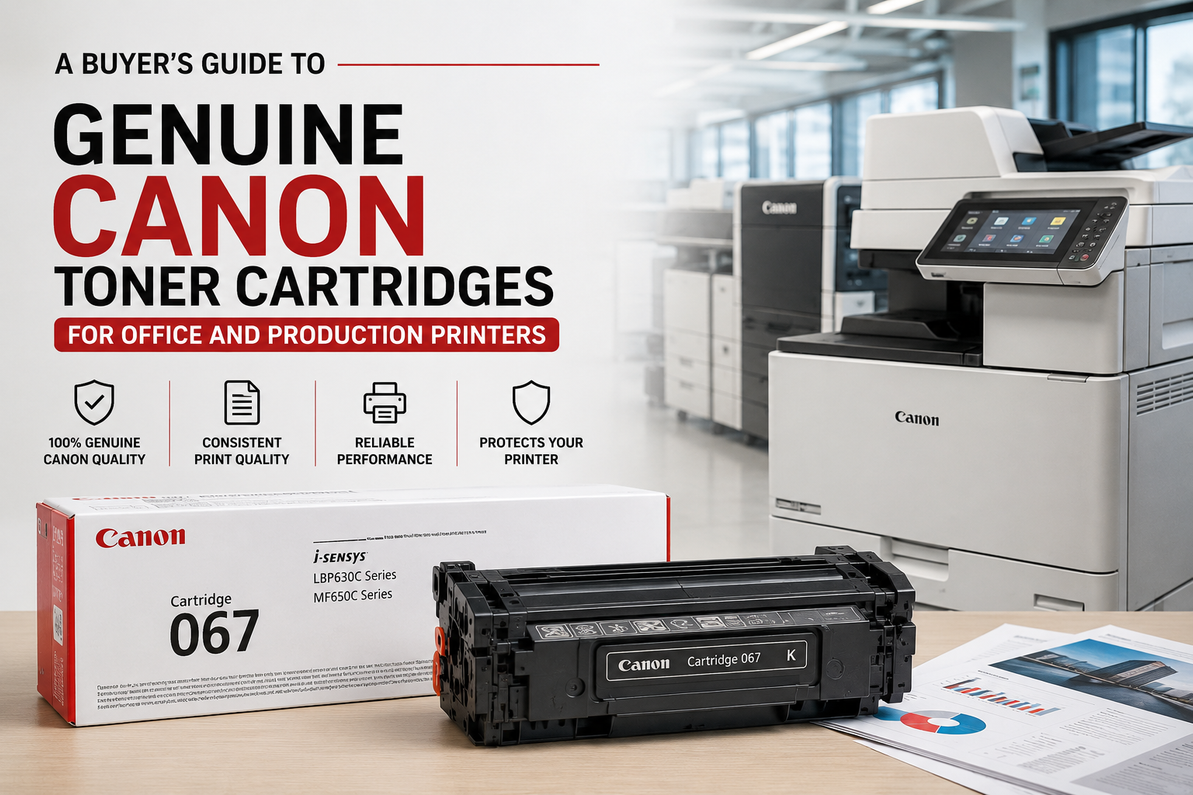
A Buyer's Guide to Genuine Canon Toner Cartridges for Office and Production Printers
If you manage print supplies for more than one printer, you already know the Canon toner aisle gets confusing fast. Between imageCLASS, imageRUNNER, i-SENSYS, and imagePRESS, the cartridge that works in the machine down the hall from you might not be the one that keeps your production printer running. Add in the price gap between genuine Canon toner and everything sitting next to it on the shelf, and it's easy to see why buyers end up guessing.
This guide walks through what "genuine Canon" actually means, how office and production cartridges differ, and how to know you're buying the right one before it ships.
What "Genuine Canon" Means
Genuine Canon toner is manufactured by Canon, for Canon printers, using Canon's own toner formula. It ships in Canon's original packaging, carries Canon's anti-counterfeiting hologram, and is built to the exact tolerances Canon engineered into that printer model. Nothing about it is guesswork.
That's different from a compatible cartridge, which is a new cartridge built by a third-party manufacturer to physically fit a Canon printer, using its own toner formula rather than Canon's. It's also different from a remanufactured cartridge, which starts life as an empty genuine Canon shell, gets cleaned, inspected, refilled, and resold. Both can be reasonable options depending on the job. Genuine is simply the version built and tested by the company that made your printer.
Why the Cartridge Matters More Than You'd Think
Laser printing isn't as simple as spraying ink onto a page. A laser charges a drum in the exact pattern of your document, toner powder clings to that charge, and a heated fuser roller melts the powder onto the paper permanently. That fusing step is unforgiving. If the toner's particle size or melting point is off even slightly, you get streaking, faded sections, or powder that never fully bonds to the page.
Canon tunes its toner formula specifically for the fuser temperature, drum speed, and imaging system in each printer family. That's the entire reason genuine cartridges perform consistently across every page of a run, and it's also why the formula in an office imageCLASS cartridge isn't interchangeable with what's inside a production imagePRESS unit.
Office Printers vs. Production Printers: Two Different Cartridge Categories
Office and workgroup printers- Canon's imageCLASS and i-SENSYS lines, are built for everyday business printing: invoices, contracts, reports, day-to-day documents. Toner cartridges here are numbered (052, 054, 057, 069, and so on), and most numbers come in a standard and a high-yield "H" version. The H cartridges typically hold roughly double the toner and print roughly double the pages of their standard counterparts, which matters if you're trying to cut down on how often someone's swapping cartridges.
Production and high-volume printers - Canon's imageRUNNER, imageRUNNER ADVANCE, and imagePRESS series, are a different animal entirely. These machines are built for commercial print environments, running anywhere from 80 to well over 150 pages per minute, with finishing options like stitching, hole punching, and tab feeding built in. Toner here usually comes under GPR (General Purpose Reload) part numbers, and yields are dramatically higher, some cartridges are rated for tens of thousands of pages rather than a few thousand.
The takeaway: know which category your printer falls into before you order. A cartridge number that works in an imageCLASS won't fit a GPR-based imageRUNNER, and vice versa.
Reading a Canon Toner Number
Canon's cartridge numbers look cryptic until you know the pattern:
- Three-digit numbers (052, 054, 057, 069, 070, 072, 075, etc.)- used across imageCLASS and i-SENSYS office models.
- "H" suffix (052H, 054H)- the high-yield version of that same cartridge, built for the same printer.
- GPR-## (GPR-18, GPR-27, GPR-29, etc.)- used in imageRUNNER and other production-class machines.
- CRG or Cartridge-prefixed numbers- an older Canon naming convention still found on some laser and fax-class models.
If you're not sure which one your printer takes, the safest source is the label on your existing cartridge or the specifications page in your printer's manual. Guessing based on the printer model alone can lead you to the wrong part.
Why Genuine Canon Costs More - and What That Premium Buys You
Printer manufacturers, Canon included, often sell hardware close to cost and make their margin on consumables over the life of the machine. It's a long-standing model in the industry, and it's part of why the toner chip in Canon cartridges reports directly to the printer and, in some cases, determines whether the cartridge is recognized at all.
That premium isn't purely markup, though. A few things you're actually paying for:
- Engineering matched the machine. The toner formula, drum, and wiper blade are built for that specific model's fuser temperature and print speed.
- Consistent page yield. Canon tests its cartridges under ISO/IEC 19752 (monochrome) and ISO/IEC 19798 (color), standardized methods that print a test page at 5% coverage until the cartridge runs dry. That gives you a reliable, apples-to-apples yield number instead of a figure pulled from marketing copy.
- Equipment protection. A poorly sealed cartridge can leak toner into the fuser or drum assembly, and that kind of damage is far more expensive to repair than the money saved on a cheaper cartridge.
- Warranty standing. Many manufacturer warranties, Canon's included, exclude damage traced back to non-OEM consumables. If a technician links a failure to a third-party cartridge, that repair cost is often on you, not Canon.
Do the Cost-Per-Page Math, Not the Sticker Math
The price on the box tells you almost nothing by itself. What matters is cost per page.
Say a genuine Canon cartridge runs $90 and prints 3,000 pages, that's 3 cents a page. A third-party cartridge at $50 that only gets you 1,200 pages before it needs replacing works out to about 4.2 cents a page. The "cheaper" option ends up costing more once you print enough volume, which is exactly why ISO-tested yield numbers matter more than the number on the shelf tag.
For office printers running moderate volume, this math is worth doing once per model. For production printers running tens of thousands of pages a month, it's worth doing continuously the difference compounds fast at that scale.
Spotting a Counterfeit Canon Cartridge
Counterfeit toner is a real problem, particularly through unfamiliar third-party marketplace sellers. A few ways to protect yourself:
- Buy from Canon directly or from an authorized, established distributor.
- Check the box for Canon's anti-counterfeiting hologram and printed serial number.
- Be skeptical of pricing that's dramatically below market that's usually the clearest red flag.
- Use Canon's online verification tools where available to confirm a serial number is legitimate.
So Which Should You Buy-Genuine, Compatible, or Remanufactured?
For client-facing documents, contracts, high-volume production runs, or any environment where a printer going down costs you real money, genuine Canon toner is the lower-risk choice. The consistency and warranty protection tend to earn back the extra cost.
For everyday internal printing where a slight variation in output isn't going to matter, a well-reviewed compatible or remanufactured cartridge can be a legitimate way to cut costs, and remanufactured cartridges have the added benefit of reusing existing hardware rather than producing new plastic from scratch.
The right call depends on your print volume, what's coming off the printer, and how much risk you're willing to carry on a machine you can't afford to have sitting idle.
The Bottom Line
Genuine Canon toner cartridges are engineered as part of the printer they're built for, not adapted to fit it afterward. That's what makes them consistent, keeps your warranty intact, and gets you the page yield printed on the box. The tradeoff is a higher upfront cost. Whether that tradeoff is worth it comes down to your printer, your print volume, and how much downtime would actually cost your business.
Frequently Asked Questions
Is genuine Canon toner worth the extra cost?
For production environments and client-facing printing, generally yes the consistency and warranty protection tend to outweigh the price gap. For light internal printing, running your own cost-per-page comparison is a better guide than the sticker price.
Will a non-genuine cartridge void my Canon printer's warranty?
It depends on the specific warranty terms. Many manufacturers, Canon included, exclude damage caused by non-OEM consumables, so it's worth checking your printer's documentation before switching.
How is Canon's page yield tested?
Canon tests under ISO/IEC 19752 for monochrome and ISO/IEC 19798 for color, both of which print standardized test pages at 5% coverage until the cartridge is empty. That makes the yield numbers comparable across cartridges and brands.
What does the "H" mean on a Canon toner number?
It marks the high-yield version of that cartridge typically around double the toner and double the page yield of the standard version, in the same physical cartridge size.
Do imageCLASS and imageRUNNER printers use the same toner?
No. imageCLASS and i-SENSYS office printers use numbered cartridges (052, 054, etc.), while imageRUNNER and other production-class machines use GPR-prefixed cartridges built for much higher volume. Check your printer's specific model before ordering.
How can I tell a genuine Canon cartridge from a counterfeit?
Buy from Canon or an authorized distributor, check for the anti-counterfeiting hologram and serial number on the box, and be cautious of pricing that seems well below market.
Recent Posts
-
Samsung Printer Ink: Choosing the Right Toner for Your Printer
If your Samsung printer has suddenly started producing pale text, uneven graphics, or documents that …20th Oct 2026 -
Dell Laser Printer Cartridges: How to Choose the Right Toner
At some point, every office using a Dell laser printer has to replace the toner. The printer may hav …18th Oct 2026 -
MFP M283fdw Toner – Compatible & Quality Cartridges
The HP Color LaserJet Pro MFP M283fdw is designed for offices that need more than basic printing. Th …14th Oct 2026